NJ PFAS – PIC Organizational Structure

NJ PFASiPIC Members

Academic Institutions:

  • New Jersey Institute of Technology
  • Princeton University
  • Rutgers University
  • Stevens Institute of Technology

Industry:

Government Agencies and Utilities

  • NJ Department of Environmental Protection
  • NJEDA Commission of Science, Innovation and Technology
  • Ridgewood Water

NJ PFAS-PIC Scope of Operations and Benefits to Members

  • NJ PFAS-PIC seed projects can be submitted by any member organization with collaborative partnerships for 
  • Translational research, application validation, compliance and scaling investigations towards further investments and commercialization from academia to industry and communities
  • Data collection and analytics studies for technology improvement/development and deployment; initiated by industry, community and government partners involving academia
  • Technology deployment and testing investigation for regulatory compliance involving multi-stakeholders and partners from academia, industry, government, utilities, consulting and community sectors
  • Promoting PFAS awareness, education and training workshops and networking events to influence policy and regulation development with community, industry and government partners.
  • Annual NJ PFAS-PIC seed grant proposal submission, review and award competition
  • Quarterly technology demonstration and work-in-progress showcases with investor and stakeholder groups
  • Round-Table IP protected deep-dive discussion, mentoring and evaluation events
  • Tech-transfer and licensing negotiation and execution with involved parties from partner organizations
  • Annual CTR sponsored NJ PFAS-PIC workshops
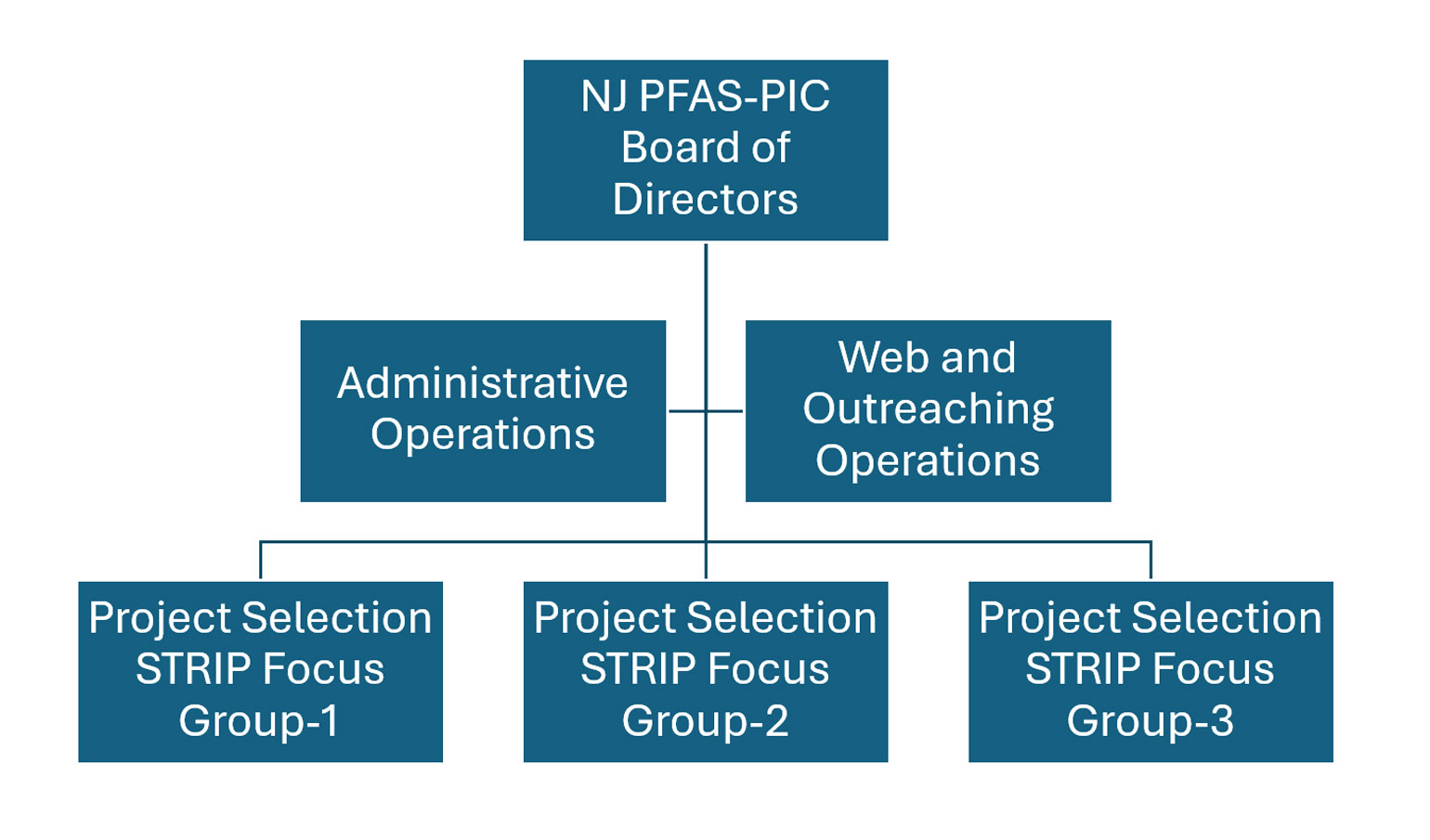
NJ PFAS-PIC Organizational Administration Structure

Board of directors structure layout

NJ PFAS-PIC Organizational Administration Structure

Lead Text:
<list>

NJ PFAS-PIC Administration Committee
Lead Text
<list>

Web and Outreaching Operations Committee
Lead Text
<list>

STRIP PFAS Focus Groups:

  • Early-Stage Translational Research and Validation (TRL 1–4): Focused on identifying key PFAS contaminants, validating detection methods and developing translational pathways for remediation, decontamination and management technologies with early field validation.
  • Advanced Translational Research and Technology Development (TRL 5–7): Centered on piloting and preparing technologies for scaling and pre-commercialization readiness for deep-dive investments.
  • Regulatory Policies and Deployment Framework: Focused on bridging detection and technology validation with regulatory and infrastructure planning for community deployment to enable scalable and sustainable impact.